
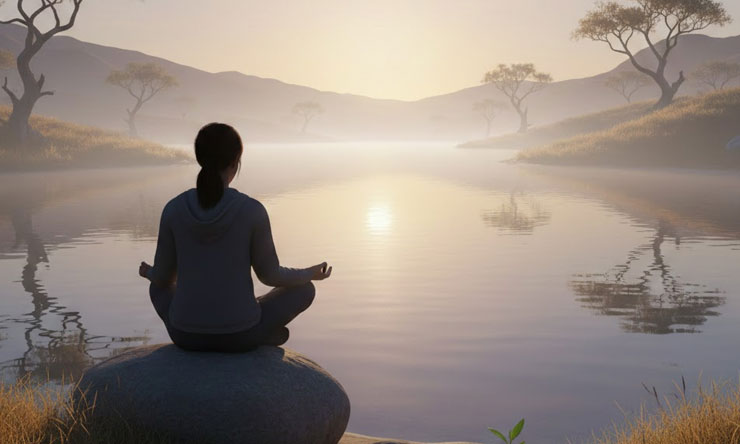
Lately, I’ve been struggling to name what I’m experiencing. I don’t feel broken enough to call it a crisis, but I don’t feel light enough to call it peace. I wake up functional, move through the day competently, answer messages, meet expectations. From the outside, everything looks fine. From the inside, it feels quieter than usual—but not in a way I fully understand.
There are moments when I think, maybe this is healing. And then there are moments when I wonder if I’m just tired in a deeper, more existential way. Not the kind of tired sleep can fix, but the kind that comes from years of carrying things without fully acknowledging their weight.
The uncertainty is what makes it strange. Healing is supposed to feel hopeful, right? Energizing? Like progress? But what if healing sometimes feels like disengagement? What if it feels like wanting less, needing less, reacting less? What if it feels suspiciously similar to exhaustion?
I don’t have a clean answer. What I have is a long pause—a state of being that sits somewhere between recovery and resignation.
When Everything Slows Down
The first thing I noticed was the slowing. Not in my schedule, but in my reactions. Things that used to provoke immediate emotion now pass through me with muted impact. I don’t rush to explain myself anymore. I don’t feel the same urgency to be understood. Arguments that once consumed my thoughts now feel oddly optional.
At first, I was proud of this. I told myself it was growth. Emotional regulation. Maturity. I had learned not to internalize everything, not to personalize every slight. That has to be healing, right?
But then I started noticing the cost of that calm. Along with less anxiety came less excitement. Along with fewer emotional spikes came fewer emotional highs. The edges of my experience felt smoother, but also flatter.
I wasn’t sad. I wasn’t happy. I was… neutral. And neutrality can be confusing when you’ve spent most of your life feeling intensely.
Some days, this stillness feels earned. Like my nervous system finally trusts that nothing catastrophic is about to happen. Other days, it feels like a protective shutdown. Like my emotions are conserving energy because they’ve been overworked for too long. Related article: A Poem I Wrote In The Middle Of A Breakdown
It’s hard to tell the difference between rest and withdrawal when both feel quiet.
The Loss of Urgency
Another change crept in quietly: the loss of urgency. I no longer feel pressured to fix everything immediately. I don’t chase closure the way I used to. Open-ended situations don’t haunt me as much. Loose ends exist, and somehow, I let them.
This could be healing. Letting go of control. Accepting uncertainty. Allowing things to unfold without micromanagement.
But it could also be fatigue. The kind that comes after trying too hard for too long. When effort stops feeling noble and starts feeling pointless. When you don’t fight because you’re enlightened, but because you’re drained.
I think about how often urgency was mistaken for passion in my past. How being constantly alert, emotionally available, and reactive was framed as care. Slowing down feels healthier, but it also feels unfamiliar. Without urgency, I sometimes wonder who I am.
There’s a strange guilt that comes with this shift. A sense that I should want more, try harder, feel stronger. Instead, I’m content with less stimulation, fewer expectations, and smaller circles. I crave simplicity, but I’m not sure if that’s wisdom or weariness.
Somewhere in this space, my mind feels like a fragile Free Space—not crowded, but also not fully furnished. There’s room to breathe, but also room where something used to live.
Emotional Honesty Without Drama
One thing I can say with certainty: I’m more honest with myself than I used to be. I no longer force optimism. I don’t label everything as a lesson or a blessing just to make it digestible. If something hurts, I let it hurt. If I don’t know how I feel, I don’t rush to define it.
This honesty is quiet. There are no grand revelations. No cinematic breakthroughs. Just small acknowledgments that accumulate over time.
I notice when I’m lonely instead of distracting myself. I admit when I’m disappointed instead of reframing it immediately. I recognize when I need rest instead of pushing through out of habit.
That feels like healing.
At the same time, this honesty comes with heaviness. Once you stop lying to yourself, you can’t unsee certain truths. You can’t go back to pretending that some dynamics don’t drain you, that some dreams no longer fit, that some versions of you are gone for good.
Healing is often marketed as empowerment, but it also involves grief. Grief for who you were before you knew better. Grief for the energy you spent surviving instead of living. Grief for the fact that awareness doesn’t automatically make things easier.
So when I feel heavy, when motivation dips, when joy feels muted, I wonder: is this the aftermath of honesty, or is it burnout finally catching up?
Rest as a Radical Act
I’ve started redefining rest. Not as reward, not as preparation for more work, but as an act in itself. Rest without justification. Rest without optimization. Read also: My Clothes Dont Match And Thats The Point
This is difficult. Productivity culture has trained me to see rest as a tool, not a need. If rest doesn’t make me better, sharper, more efficient, it feels indulgent. But what if rest doesn’t owe me growth? What if it’s allowed to exist simply to sustain me?
On days when I allow myself to rest emotionally—not analyze, not improve, not plan—I feel closer to healing. On days when rest turns into avoidance, when I disengage from everything and everyone, it feels more like exhaustion.
The line between the two is thin and constantly moving.
I’m learning that healing doesn’t always feel active. Sometimes it feels like stillness. Like sitting in unanswered questions without trying to resolve them. Like choosing not to react, not because you’re numb, but because you trust that you don’t need to.
And yes, sometimes it probably is just tiredness. The kind that demands compassion, not interpretation.
Conclusion
Maybe this is healing, or maybe I’m just tired. Maybe it’s both, happening at the same time in ways that don’t need to be separated yet.
I don’t think everything needs to be labeled immediately. Not every quiet phase needs a narrative. Not every low-energy season is a problem to solve. Some states of being are transitional, meant to be lived through rather than explained.
What I know is this: I’m no longer forcing myself to feel a certain way to prove progress. I’m allowing ambiguity. I’m listening to my limits. I’m choosing gentleness over intensity, even when I don’t fully understand why.
If this is healing, it’s slower and less glamorous than I expected. If this is exhaustion, then rest is not a failure—it’s a response.
Either way, I’m here. Present. Honest. And for now, that’s enough.