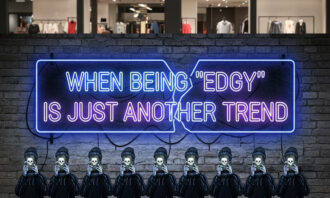
Punk was never meant to be comfortable. It was loud, abrasive, political, and deliberately ugly. Emerging in the mid-1970s amid economic decline, youth unemployment, and social alienation, punk positioned itself as an outright rejection of mainstream values. It challenged authority, mocked consumerism, and embraced a raw do-it-yourself ethos that prioritized expression over polish. Punk was not just music or fashion; it was a way of saying no—to systems that felt oppressive, exclusionary, and hollow.
Yet today, punk aesthetics are everywhere. Safety pins appear on luxury runways, ripped jeans are mass-produced, and the word “punk” is used to sell perfumes, sneakers, and advertising campaigns. What was once a symbol of rebellion now circulates freely within the very systems it sought to dismantle. This transformation raises an uncomfortable question: how did punk go from rebellion to retail, and what does this journey say about the long death of subculture in the modern world? You may also like: When Aesthetics Replace Beliefs
Punk as Resistance, Not a Style
To understand punk’s decline, it is crucial to remember what punk originally stood for. Punk was born out of frustration and scarcity. In cities like London and New York, young people with limited economic prospects used music and art to articulate anger toward political elites, rigid class systems, and cultural gatekeeping. The sound was fast and aggressive because resources were limited. The fashion was torn and improvised because buying into mainstream style was both unaffordable and undesirable.
Punk rejected virtuosity and professionalism. Anyone could start a band, design a flyer, or organize a show. This openness was central to its political meaning. Punk did not ask for permission, nor did it aim for mass approval. Its power came from its refusal to be palatable. Lyrics were confrontational, performances were chaotic, and aesthetics were intentionally anti-commercial.
Most importantly, punk existed as a lived practice. It thrived in small venues, squats, independent record labels, and zines passed hand to hand. These spaces created communities that valued autonomy and mutual support over profit. Punk’s identity was inseparable from its opposition to corporate control and cultural conformity.
Seen this way, punk was never just an aesthetic that could be detached from its context. It was a response to material conditions and social exclusion. Once those conditions changed—or once punk was removed from them—its meaning inevitably shifted.
Absorption, Commodification, and the Market Logic
The beginning of punk’s transformation did not come from within alone. As punk gained visibility, it attracted attention from media and industry. What started as a threat to the status quo was gradually reframed as an edgy trend. Record labels signed punk bands, magazines aestheticized the look, and fashion brands borrowed visual elements while stripping away political content.
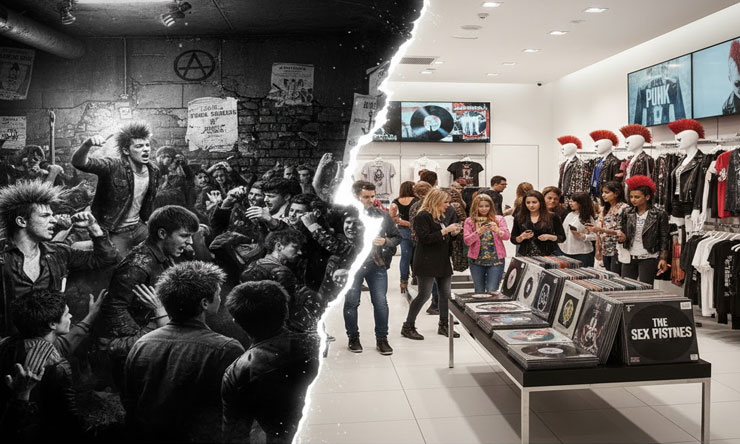
This process is not unique to punk. Capitalism has a remarkable ability to absorb critique by turning it into a product. Rebellion becomes branding. Dissent becomes style. Once punk aesthetics entered the marketplace, they became reproducible, scalable, and profitable. The safety pin lost its confrontational meaning when it could be bought pre-distressed in a mall.
As punk entered retail spaces, its original barriers dissolved. You no longer needed to participate in a community, share values, or challenge authority to look punk. Identity was reduced to consumption. This shift marked a crucial turning point: punk stopped being something you did and became something you wore.
Over time, repetition further hollowed it out. Each revival recycled the same symbols—leather jackets, mohawks, ripped shirts—without the urgency that once animated them. What remained was nostalgia, not resistance. Punk became a reference to a past rebellion rather than a living force.
In the middle of these transformations, discussions about culture reveal a broader pattern: systems that dominate production and distribution tend to neutralize opposition by aestheticizing it. Punk did not disappear because it failed; it was slowly disarmed by success and visibility.
The Long Death of Subculture in the Digital Era
Punk’s decline also reflects deeper changes in how subcultures function today. In the past, subcultures depended on physical proximity, shared risk, and relative invisibility. They grew slowly and developed internal norms before reaching wider recognition. This incubation period allowed meaning to solidify.
In the digital age, this process has collapsed. Social media accelerates exposure, and algorithms reward visibility over depth. As soon as a subcultural signal appears, it is documented, shared, and replicated at scale. Brands monitor these signals closely, ready to translate them into products almost instantly. There is little time for values to mature before aesthetics are extracted.
This environment makes it difficult for movements like punk to exist in their original form. The distance between rebellion and commodification has shortened dramatically. What once took decades now takes months, or even weeks. As a result, subcultures struggle to maintain autonomy long enough to develop coherent political or social identities.
Additionally, risk has changed. Punk once involved social and sometimes physical danger—conflict with authorities, exclusion from mainstream spaces, and economic precarity. Today, expressing “punk” often involves minimal consequence. Without risk, rebellion loses intensity. It becomes symbolic rather than disruptive.
This does not mean resistance is impossible, but it does suggest that its forms must adapt. Punk’s long death is less about betrayal and more about structural transformation. The conditions that allowed punk to thrive no longer exist in the same way.
Conclusion
From rebellion to retail, punk’s journey tells a larger story about the fate of oppositional movements in a hyper-commercialized world. Punk did not simply sell out; it was gradually absorbed, aestheticized, and neutralized by systems designed to turn difference into profit. What remains today is a visual echo of something that once carried genuine social and political force. Recommended: My Favorite Memories Dont Have Photos
Punk’s long death matters because it reveals how difficult it is for radical ideas to survive unchanged within dominant economic and media structures. It also challenges romantic notions of subculture as inherently resistant. Without material conditions, community, and risk, rebellion becomes a costume rather than a practice.
Yet the story does not end in total loss. Punk’s legacy persists in its influence on independent creativity, DIY ethics, and skepticism toward authority. While punk itself may no longer function as a living movement, its core impulse—the refusal to accept imposed limits—continues to resurface in new forms.
Understanding punk’s transformation helps us ask better questions about resistance today. In an age where everything can be branded, the challenge is not just to look rebellious, but to create spaces and practices that cannot be easily sold back to us. That struggle remains central to the future of culture.