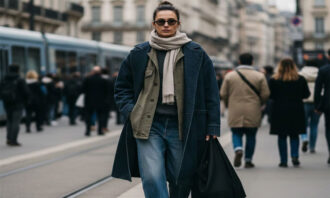
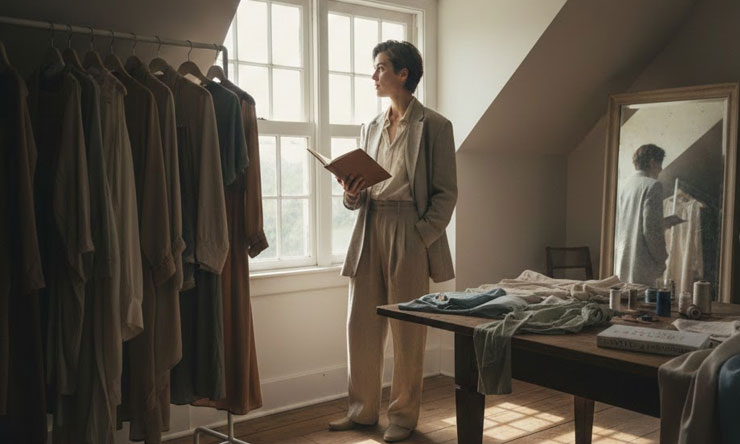
There is a familiar assumption that follows certain clothes the moment they appear. A sharper silhouette, a darker palette, an unexpected texture, a sudden consistency where there once was variation. The response is often casual, even well-meaning: “Oh, are you in a phase?” As if clothing were a temporary symptom, a mood swing made visible, something to be waited out until normalcy returns.
This assumption reduces personal style to a narrative arc that must eventually resolve. It treats appearance as evidence of instability rather than intention. In doing so, it overlooks a simpler truth: not every change is a transition, and not every consistency is a costume. Sometimes an outfit is not a signal of becoming, but of arrival.
To say “this doesn’t mean I’m in a phase” is not defensive. It is clarifying. It is a refusal to let clothing be interpreted as confusion when it may, in fact, reflect clarity.
Why Style Is Often Mistaken for Instability
The idea of a “phase” implies impermanence. It suggests experimentation without commitment, a flirtation with identity rather than a grounded choice. This framing is deeply embedded in how society reads appearance. When someone’s clothing deviates from an earlier version of themselves, the change is often psychologized. New clothes are treated as clues to an internal crisis or transformation.
This reaction reveals more about the observer than the wearer. People rely on visual consistency to categorize others. When that consistency shifts, it can create discomfort. Labeling the change as a phase is a way to restore order. It reassures the observer that the person will return to a recognizable version soon.
There is also a cultural habit of trivializing self-directed choices. When someone commits to a look that is not easily explained by trends, age, or social role, it disrupts expectations. Calling it a phase minimizes its seriousness. It reframes intention as impulse.
In reality, many people arrive at a more consistent style only after years of fluctuation. The experimentation came first. The repetition came later. What looks sudden from the outside is often the result of long internal editing. The wardrobe narrows not because options disappeared, but because preferences solidified.
Another reason style is mistaken for instability is that we are accustomed to constant reinvention. Trend cycles reward change for its own sake. In that environment, consistency appears suspicious. If fashion is supposed to move, then standing still looks like regression or fixation. But stillness can also be a sign of confidence.
When someone wears similar silhouettes repeatedly, or returns to the same colors and shapes, it is often because those choices support their daily life. They reduce decision fatigue. They feel aligned. They function. None of this suggests a phase. It suggests resolution. Don’t miss: This Isnt A Story Just A Feeling I Needed To Share
Clothing as Continuity, Not Experiment
There is a difference between trying something on and settling into it. Phases are usually marked by intensity and volatility. They burn bright and then exhaust themselves. Continuity, on the other hand, is quieter. It repeats without needing justification.
When clothing becomes continuous, it starts to act like infrastructure rather than decoration. The outfit is no longer the point. It is a background element that allows the person to focus elsewhere. This is often misread because it lacks spectacle. There is no dramatic narrative attached to it.
Continuity in style often emerges alongside other forms of self-trust. People begin to dress less for interpretation and more for alignment. They choose clothes that match their pace, their environment, their tolerance for attention. The result may look austere or specific, but it is usually deeply practical. Worth reading: Letting Go Of Who You Thought Youd Be
The assumption of a phase also ignores the possibility that identity is not linear. People do not move neatly from one version of themselves to another. They accumulate. They refine. Clothing reflects this accumulation. What looks like a departure may actually be a distillation.
There is also a subtle power dynamic at play. Suggesting that someone is “in a phase” positions the speaker as more stable, more settled. It implies that the wearer’s choices are provisional, while the observer’s norms are permanent. This imbalance is rarely intentional, but it is real.
Rejecting this framing does not require explanation. It does not require a manifesto or backstory. The refusal can be quiet. A consistent wardrobe over time often answers the question more effectively than words. Repetition becomes proof.
This is where unstyle often takes shape. Not as an aesthetic declaration, but as a byproduct of coherence. When clothing stops changing to satisfy external narratives, it begins to reflect internal ones. The look stabilizes, not because it is rigid, but because it is sufficient.
Conclusion
No, this outfit doesn’t mean I’m in a phase, because not everything needs to be temporary to be valid. Clothing can mark growth without signaling transition. It can reflect arrival rather than experimentation. When style settles, it is often because the person wearing it has settled into themselves.
The urge to label appearance as a phase reveals a discomfort with autonomy. It suggests that personal choices must always be explained, contextualized, or justified. But clothing does not owe clarity to observers. It does not need to narrate a journey or promise an endpoint.
In a culture that celebrates constant reinvention, choosing continuity can feel quietly radical. It resists the pressure to perform evolution on demand. It allows identity to exist without commentary. Over time, this approach often leads to unstyle—not as rebellion, but as relief.
An outfit can simply be an outfit. Not a signal, not a symptom, not a phase. Just something that works, day after day, without asking to be interpreted. And sometimes, that is the most stable choice of all.