
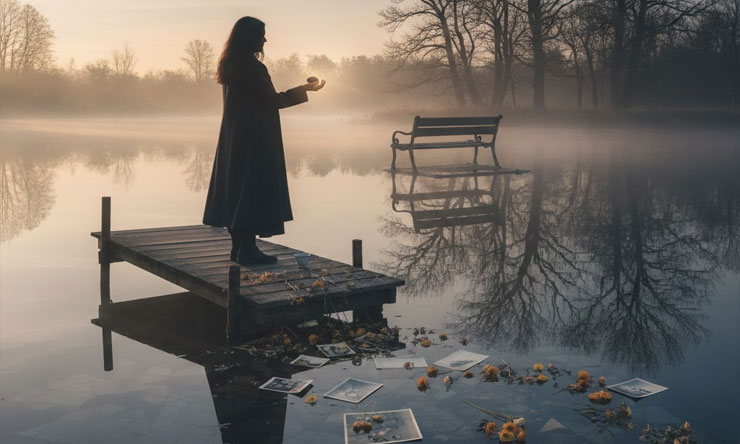
There are scenes that leave your life quietly but never leave your head. They don’t announce themselves as important when they happen. They look ordinary, almost forgettable. And yet, something about them refuses to settle. They return uninvited—while you’re washing dishes, staring out of a window, trying to fall asleep. You replay them not because you enjoy the memory, but because your mind believes there is still something unresolved inside it.
This is one of those scenes.
Nothing dramatic happened. No raised voices, no irreversible decisions. If I tried to explain it to someone else, it would sound trivial. But meaning doesn’t always correlate with intensity. Sometimes it hides in subtlety, in the things that almost happened, in the words that were chosen instead of the ones that wanted to be said.
I keep replaying the scene not to change it, but to understand why it mattered so much.
The Moment Itself
It was brief. A pause, really. A conversation that slowed down just enough for awareness to slip in.
We were talking about something inconsequential—plans, schedules, everyday logistics. The kind of conversation that fills time without demanding presence. And then there was a silence. Not awkward, not heavy. Just long enough to feel it.
In that pause, I noticed something shift. Not externally, but internally. I became aware of what I wasn’t saying. Of how carefully I was choosing neutrality. Of how many thoughts were being edited before they ever reached my mouth.
I remember looking at the other person and realizing that this was one of those moments where honesty could have changed the direction of everything. Not honesty as in confession, but honesty as in tone. A softer answer. A braver question. A willingness to say, “This actually matters to me.”
Instead, I smiled. I nodded. I continued as if nothing was at stake.
The scene ends there. No conflict. No resolution. Just continuation.
That’s what makes it so persistent.
Why My Mind Won’t Let It Go
If the scene had ended badly, I could categorize it as regret. If it had ended beautifully, I could call it nostalgia. But it ended neutrally, and neutrality is hard for the mind to file away.
My brain keeps circling back, asking quiet questions. What was I protecting myself from? What did I assume would happen if I spoke more honestly? Why did I choose comfort over clarity?
The replay isn’t about rewriting the past. It’s about interrogating the pattern. That scene represents a familiar habit: minimizing myself to keep things smooth. Avoiding emotional risk in favor of predictability. Choosing to be easy rather than real.
What unsettles me is not that I stayed silent, but how automatic it was. The reflex didn’t come from fear alone—it came from practice. From years of learning when it’s safer to stay contained.
Every time the scene replays, I notice something new. Sometimes it’s my body language. Sometimes it’s the tone of my voice. Sometimes it’s the realization that I wasn’t misunderstood—I was unexpressed.
That distinction matters.
The Weight of What Wasn’t Said
We often assume that unsaid words disappear. They don’t. They accumulate. They turn into tension, into distance, into a vague sense of dissatisfaction that’s hard to trace back to its source.
In that scene, what I didn’t say wasn’t dramatic. It was honest. It was human. It was something like, “I care more than I’m letting on,” or “I’m not as unaffected as I seem.”
The cost of not saying it wasn’t immediate. That’s why it was easy to dismiss. The cost came later, in the form of restlessness. Of replay. Of wondering why the connection felt incomplete even though nothing technically went wrong.
This is where memory becomes less about the past and more about instruction. The mind doesn’t replay scenes randomly. It replays the ones that carry unfinished information.
In revisiting that moment, my thoughts open into a kind of Free Space—a mental area where I’m not judging the decision, just observing it. Where I can ask not “Why did I mess up?” but “What does this tell me about how I move through the world?”
That space isn’t comfortable, but it’s honest.
The Illusion of Control
Part of why the scene stays with me is because it challenges my sense of control. I like to believe that I’m intentional, that my choices are deliberate. But that moment reveals how often decisions are made by habit rather than thought.
I didn’t choose silence after weighing options. I defaulted to it.
That realization is humbling. It suggests that there are versions of me operating on autopilot, prioritizing safety over authenticity without conscious consent. It raises the question: how many other moments have passed this way without being noticed?
Replaying the scene becomes a way of slowing time down after the fact. Of giving myself the awareness I didn’t have in the moment. It’s not about punishment—it’s about recognition.
And maybe that’s the real discomfort. Not that I stayed silent, but that I didn’t realize I was doing it until later.
Learning to Let the Scene Teach Me
I don’t think the goal is to stop replaying the scene entirely. Some memories fade only after they’ve taught us what they’re meant to teach.
This one is teaching me to pay attention to pauses. To the moments that feel deceptively small. To the internal flinch that happens right before I choose ease over expression.
It’s teaching me that honesty doesn’t always look like big declarations. Sometimes it looks like allowing a sentence to be slightly truer than planned. Slightly more vulnerable than rehearsed.
Most importantly, it’s teaching me that replay doesn’t mean obsession. It can mean integration. The mind returning to a moment until the lesson is fully absorbed.
Conclusion
The scene I keep replaying isn’t a mistake frozen in time. It’s a message still being delivered.
It reminds me that presence is fragile, that opportunities for authenticity don’t announce themselves loudly, and that silence—while often protective—can also be a form of self-erasure when used too automatically.
I don’t replay the scene because I want to go back. I replay it because I want to move forward differently. With more awareness. With less fear of disruption. With a better understanding of when to stay quiet and when to speak.
Some scenes stay with us not because they define us, but because they’re trying to refine us.
And maybe one day, the replay will stop—not because I forgot the moment, but because I finally listened to what it was asking of me.