
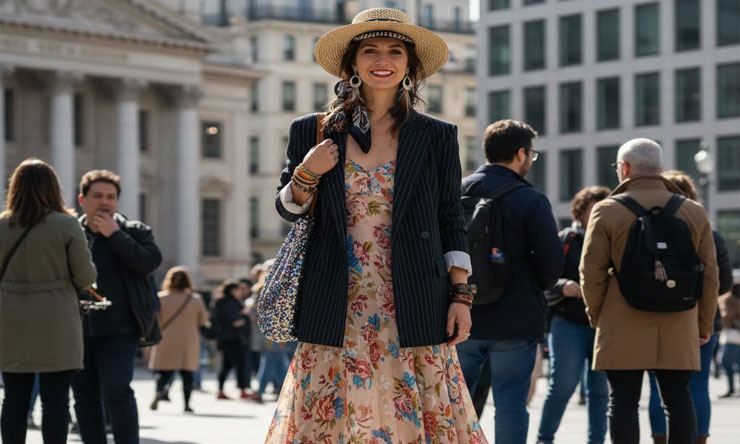
There is a quiet rule embedded deep in how we are taught to dress: things must “go” together. Colors should harmonize. Silhouettes should balance. Textures should make sense in relation to one another. When they don’t, the result is often described as wrong, messy, or careless. The assumption is simple—if clothes don’t go together, the wearer didn’t try hard enough.
But what if that assumption misses the point?
Wearing clothes that don’t “go” together can be an intentional refusal of visual logic imposed from the outside. It can be a way of stepping out of aesthetic obedience and into personal tolerance for dissonance. Not everything has to resolve. Not everything has to make sense. Sometimes, clothing can exist the way thoughts and moods do: uneven, layered, and unresolved.
This is not about chaos for attention. It is about loosening the grip of coherence where coherence is not needed.
The Tyranny of Matching and Visual Correctness
From early on, style education revolves around harmony. Matching shoes to bags. Coordinating colors. Avoiding clashes. These rules are often framed as neutral advice, but they carry value judgments. Matching is associated with care, competence, and social awareness. Mismatching is linked to immaturity, rebellion, or ignorance.
Over time, these associations become internalized. People learn to read “going together” as a moral signal rather than a practical one. An outfit that clashes is not just seen as visually off—it is seen as socially off.
This creates a narrow corridor of acceptable appearance. Even when trends encourage experimentation, they often do so within curated boundaries. Clashing is allowed only when it is clearly intentional, aestheticized, and legible as fashion. Randomness, by contrast, is still suspect.
The pressure to make clothes go together also reinforces the idea that outfits must communicate control. Everything must look deliberate. Nothing should appear accidental. This expectation mirrors broader cultural discomfort with ambiguity. We prefer things that resolve cleanly, that tell a clear story.
But lived experience is rarely that tidy. People are inconsistent. Moods shift. Contexts overlap. Dressing according to perfect visual logic can feel disconnected from that reality. The insistence on matching becomes less about practicality and more about managing perception.
When clothes must always go together, dressing becomes a performance of competence. You are not just wearing fabric; you are demonstrating that you understand the rules.
Dissonance as an Honest State
Wearing clothes that don’t go together introduces dissonance—and dissonance is often treated as a flaw. But dissonance can also be descriptive. It reflects the way many people actually move through the world: carrying conflicting energies, responsibilities, and desires at the same time.
An outfit that doesn’t go together can mirror that complexity. A formal coat over casual shoes. Soft colors clashing with harsh lines. Old pieces paired with new ones without smoothing the transition. These combinations resist summary. They don’t settle into a single aesthetic explanation.
This resistance can feel uncomfortable, especially at first. Without visual harmony, the outfit stops reassuring others. It no longer signals effort in familiar ways. The wearer may feel exposed—not because the clothes are revealing, but because they are unreadable.
Yet that unreadability can be freeing. When an outfit doesn’t go together, it stops inviting judgment based on established criteria. There is no clear benchmark for success or failure. The clothes are no longer competing for approval.
Dissonant dressing also disrupts the hierarchy of pieces. In a “matched” outfit, there is often a clear focal point. In an unmatched one, attention disperses. Nothing dominates. The look becomes less about display and more about coexistence.
This coexistence does not require explanation. It does not need to be framed as irony, rebellion, or commentary. It can simply be the result of choosing what feels available, comfortable, or necessary in that moment.
Over time, wearing clothes that don’t go together can recalibrate internal standards. The fear of clashing diminishes. The need for resolution fades. Dressing becomes less about achieving a visual endpoint and more about assembling a temporary arrangement that supports the day.
This is where many people find themselves drifting toward unstyle—not as a declared philosophy, but as a practical outcome. When matching stops being a priority, meaning loosens. Clothes stop working as symbols and start functioning as companions.
Letting Clothes Coexist Without Explanation
One of the most radical aspects of wearing clothes that don’t go together is the refusal to explain. In a culture that expects intention behind every visual choice, mismatching often triggers curiosity. Is this on purpose? Is it ironic? Is it a statement?
The answer does not have to exist.
Letting clothes coexist without explanation removes them from narrative duty. They no longer need to express identity, mood, or awareness. They are simply there, sharing space on the body without resolving into a message.
This approach shifts the relationship between the wearer and the observer. The observer is no longer guided toward interpretation. The outfit offers no clear entry point. For some, this is unsettling. For the wearer, it can be deeply stabilizing.
Without the obligation to make sense visually, dressing becomes faster and quieter. Pieces are chosen because they are clean, comfortable, or suited to the weather—not because they harmonize. The wardrobe stops behaving like a system and starts acting like a pile.
A pile is not careless. It is flexible. Things can be taken from it without considering how they relate to everything else. Each item stands on its own usefulness.
This does not eliminate aesthetic pleasure. You may still enjoy texture, proportion, and contrast. But these pleasures are incidental rather than governing. They arise organically rather than being engineered.
There is also less disappointment. When clothes are not expected to go together, there is no failure when they don’t. The standard disappears. The outfit does not collapse under scrutiny because it was never meant to resolve.
This mindset can extend beyond clothing. It trains tolerance for ambiguity. It allows contradictions to exist without forcing reconciliation. It accepts that not everything needs to align to be functional.
In this sense, wearing clothes that don’t go together is not about visual rebellion. It is about practicing comfort with incompleteness.
Conclusion
Wearing clothes that don’t “go” together challenges the assumption that harmony equals care and dissonance equals neglect. It reveals how deeply we associate matching with correctness—and how unnecessary that association often is.
When clothes stop needing to align visually, they become lighter. They lose their role as proof of effort or awareness. They stop signaling competence and start offering support. Dressing becomes an act of assembly rather than performance.
This approach does not reject aesthetics. It simply decouples them from obligation. It allows outfits to be temporary, uneven, and unresolved. Over time, this often settles into unstyle—not as a deliberate look, but as an ease with not needing one.
Not everything has to go together to work. Clothes can coexist the way thoughts do: overlapping, contradictory, and sufficient as they are. And sometimes, letting them remain that way is the most honest form of dressing there is.