
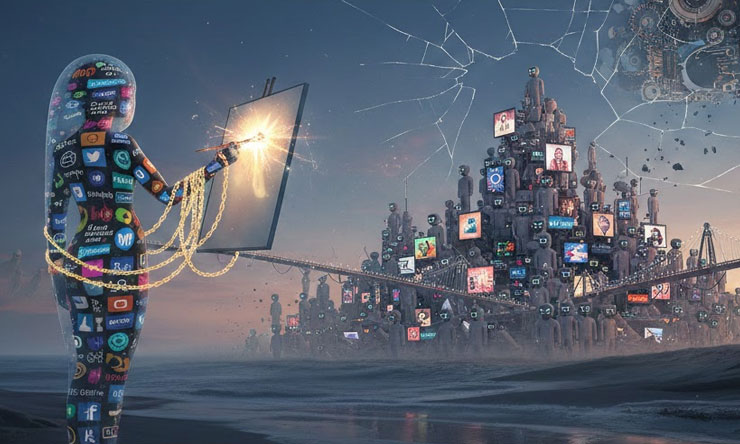
Not long ago, the idea of “having a brand” was reserved for companies, celebrities, or public figures with something specific to sell. Today, that boundary has dissolved. Artists, freelancers, students, activists, and even people with no commercial ambitions are encouraged—sometimes pressured—to think of themselves as brands. Your social media presence, your tone of voice, your visual style, and even your opinions are expected to be coherent, recognizable, and strategically curated.
At first glance, this shift seems empowering. Branding promises control, visibility, and opportunity. If everyone is a brand, then everyone has a chance to be seen. But beneath this promise lies a growing unease. When identity becomes a product and self-expression turns into positioning, something fundamental begins to erode. The problem is not branding itself, but what happens when branding becomes the default way of being a person in public.
How Personal Branding Became Inevitable
The rise of personal branding did not happen overnight, nor was it purely ideological. It emerged from structural changes in work, media, and technology. As stable career paths declined and gig-based labor expanded, individuals were encouraged to market themselves. Freelancers needed portfolios, creators needed audiences, and professionals needed “online presence.” Visibility became currency.
Social media platforms accelerated this process. They blurred the line between personal and professional life, turning everyday interactions into potential opportunities. Profiles function as resumes, feeds as highlight reels, and follower counts as social proof. Even outside explicitly professional contexts, people learn quickly that consistency is rewarded. A clear niche, a recognizable personality, and a predictable tone attract attention and engagement.
Over time, branding logic seeps inward. People begin to think in terms of audience reaction before speaking. They ask whether a post “fits” their image, whether an opinion aligns with their perceived values, whether silence or performance is safer. Identity becomes something to manage rather than explore.
This shift is reinforced by platform incentives. Algorithms favor clarity over complexity. Contradiction confuses systems designed to categorize. As a result, individuals are encouraged to present themselves as stable, legible entities. Growth becomes optimization. Expression becomes strategy.
The problem here is subtle but profound. Branding requires reduction. To be recognizable, something must be simplified. When applied to people, this simplification narrows identity. The messy, evolving, contradictory nature of human experience is compressed into a marketable narrative. You are not just yourself—you are a version of yourself that performs well.
What Gets Lost When Identity Becomes a Product
When everyone is a brand, authenticity changes meaning. Being “real” no longer means being honest; it means being consistent. Deviations feel risky because they threaten the integrity of the brand. Changing your mind can look like inauthenticity. Growth can be misread as inconsistency. Silence can be interpreted as irrelevance.
This environment discourages vulnerability. True vulnerability is unpredictable and often unresolved. It does not package neatly into content. Branded vulnerability, by contrast, is curated, contextualized, and safely distanced from real risk. It reassures the audience while preserving the image. Over time, people learn to share only what reinforces their narrative.
Relationships also change under branding pressure. Interactions become performative. Conversations feel like extensions of one’s public identity. Even empathy can be filtered through visibility—what is shared, what is liked, what is acknowledged publicly. When everything is potentially content, presence loses intimacy.
Creativity suffers as well. Branding rewards repetition. Once something “works,” deviation feels inefficient. Artists and thinkers may feel trapped by the expectations they helped create. Audiences want the familiar version, not the evolving one. Innovation becomes a liability.
Psychologically, the cost is heavy. Constant self-monitoring creates anxiety. There is pressure to be on, to be relevant, to be aligned. Failure feels public, not private. Rest feels unproductive. The self is never offstage.
In the middle of this dynamic, discussions about culture become unavoidable. A culture that treats people as brands prioritizes visibility over depth and performance over presence. It reshapes values subtly, teaching individuals to think of themselves as products in competition rather than participants in shared social life.
Why Branding Logic Can’t Fix Human Complexity
Branding works well for products because products are meant to be consistent. People are not. Applying market logic to identity creates friction because human beings change. They contradict themselves. They outgrow old beliefs. They experiment, retreat, and re-emerge.
When branding logic dominates, these natural processes feel like failures. Instead of being part of life, uncertainty becomes something to hide. Ambivalence becomes weakness. Complexity becomes confusion. The result is a public sphere filled with polished certainty and private confusion.
There is also a moral cost. When identity is branded, values can become performative. Beliefs are expressed because they align with an image, not because they are fully lived or understood. This does not mean people are insincere, but it does mean that expression is often shaped by external validation. Ethics become aesthetics.
Moreover, branding encourages individual solutions to structural problems. If success depends on how well you market yourself, failure becomes personal. Burnout becomes a branding issue. Insecurity becomes a confidence problem. This obscures systemic inequalities and shifts responsibility inward.
It is important to note that opting out is not equally available to everyone. For many, branding is tied to economic survival. Artists need visibility. Freelancers need clients. Marginalized voices may rely on platforms to be heard. The issue is not individual choice, but the absence of alternatives.
Resisting branding logic does not mean rejecting visibility altogether. It means questioning the assumption that everything must be optimized, coherent, and marketable. It means creating spaces where people are allowed to be unfinished, inconsistent, and quiet without penalty.
Conclusion
Everyone being a brand feels normal now, but normal does not mean healthy. The widespread adoption of branding logic has reshaped how people see themselves and others. It promises empowerment but often delivers pressure. It offers visibility but demands simplification.
The problem is not that people want to be seen. It is that being seen has become conditional on performance. Identity is no longer just lived; it is managed. Expression is no longer just shared; it is evaluated.
Reclaiming something human in this landscape requires intention. It means allowing room for change without explanation, for silence without disappearance, and for expression without strategy. It means remembering that people are not products, and meaning cannot always be measured.
In a world where branding feels unavoidable, choosing to be more than a brand becomes a quiet form of resistance. It is a reminder that identity is not a pitch, life is not a campaign, and culture should make room for complexity, not flatten it.