
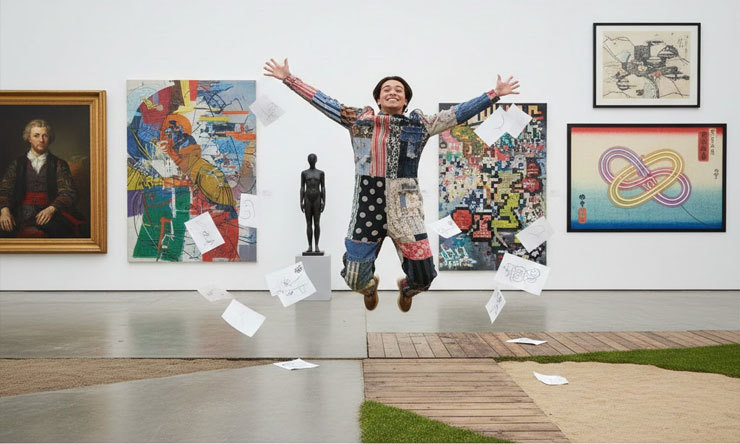
There is a growing expectation that personal style should have a center. A core. Something definable, repeatable, and easily summarized. Minimalist. Vintage. Streetwear. Classic. Experimental. We are encouraged to locate ourselves within a stable aesthetic identity, as if clothing were meant to resolve into a single, recognizable statement.
But what if it doesn’t?
What if style doesn’t orbit a core at all? What if it drifts, contradicts itself, changes rhythm, or refuses to settle—and that refusal is not confusion, but comfort?
Saying “my style has no core” is often heard as uncertainty. As indecision. As lack of taste or commitment. Yet for some people, the absence of a core is not a problem to solve. It is the point. It is what allows clothing to remain flexible, responsive, and unburdened by narrative.
Liking it this way is not about chaos. It is about rejecting the demand for coherence where none is needed.
The Pressure to Be Legible Through Style
Style culture increasingly values clarity. A strong “point of view.” A recognizable silhouette. A feed that makes sense at a glance. Whether online or offline, legibility has become a form of currency. If your style has a core, others know how to read you. They know what you’re about.
This pressure doesn’t come only from fashion media. It shows up in casual questions: “What’s your style?” “Are you more minimalist or eclectic?” These questions assume that a stable answer exists—and that it should.
For many people, this demand creates unnecessary friction. Not everyone experiences clothing as a linear identity project. Some dress based on mood, context, energy, or availability. Some repeat outfits obsessively for weeks and then abandon them overnight. Some move between aesthetics without seeing those shifts as meaningful transitions.
Yet without a core, style is often framed as lacking seriousness. Inconsistency is mistaken for indecision. Variation is treated as noise instead of information. The underlying assumption is that authenticity requires definition.
But legibility is not the same as honesty. Being easy to categorize does not necessarily mean being aligned. A core can be helpful—but it can also become a constraint. Once you declare one, it starts asking to be maintained.
This maintenance can quietly turn style into labor. You begin editing choices not based on comfort or interest, but on whether they “fit” the identity you’ve established. Over time, the core becomes less descriptive and more prescriptive. You stop asking what works today, and start asking what stays on brand.
For those who don’t feel anchored to a single aesthetic logic, this is exhausting. And unnecessary.
Incoherence as Freedom, Not Failure
Having no core does not mean having no taste. It means taste is situational rather than centralized. It adapts. It responds. It contradicts itself without apology.
One day, structure feels grounding. Another day, softness does. One season invites repetition; another invites novelty. None of this needs to be resolved into a story. Clothing can function as a toolset rather than a thesis.
Incoherence, in this sense, is not randomness. It is responsiveness. The wardrobe becomes a collection of options rather than a system. Pieces are chosen because they feel right in the moment, not because they reinforce a long-term image.
This approach often looks messy from the outside. It resists summary. It confuses observers who expect continuity. But internally, it can feel remarkably calm. There is no pressure to explain why today looks different from yesterday. No anxiety about breaking character.
When style has no core, clothing stops carrying identity weight. It no longer needs to prove consistency, depth, or evolution. It simply participates in daily life.
There is also less fear around change. If nothing is anchored to a central aesthetic, nothing is at risk when preferences shift. New pieces don’t threaten an identity; they just join the mix. Old ones can rest without being framed as outdated or abandoned.
This is particularly freeing in a culture that treats personal style as a public statement. Without a core, there is no statement to defend. No position to clarify. You are not “going through something” just because your clothes don’t align with last month’s version of you.
For many, this lack of core leads naturally toward unstyle—not as a conscious rejection of fashion, but as a byproduct of disengagement from its narrative demands. Clothes are worn because they are available, comfortable, or appealing in that moment. Meaning becomes incidental rather than intentional.
Living Without an Aesthetic Center
Living without a style core changes how you relate to your wardrobe. Decisions become quieter. Less symbolic. More practical.
You stop asking whether something “fits your style” and start asking whether it fits your day. The criteria shift from coherence to usefulness. Can you move in it? Can you forget about it? Can it carry you through what you need to do?
This often results in surprising patterns. You may notice phases of repetition—not because you’ve found your true aesthetic, but because certain clothes temporarily support your life better than others. When that changes, the repetition fades. Nothing is lost.
Importantly, this does not eliminate care. You can still appreciate design, texture, color, and form. You can still enjoy dressing up or standing out when you choose. The difference is that these moments are optional, not obligatory. They are events, not maintenance.
Without a core, there is also less pressure to archive the self. Photos don’t need to align. Outfits don’t need to tell a story across time. The past does not dictate the present. Clothing exists in fragments, just like lived experience.
This fragmentation mirrors how many people actually feel. Identity is not always a single thread. It can be layered, contradictory, and unresolved. Allowing style to reflect that complexity—without forcing it into a brand—can feel deeply honest.
There is a subtle confidence in this approach. It does not ask to be understood. It does not require validation. It simply exists. And because it exists without explanation, it becomes surprisingly resilient.
Trends pass through without disruption. Opinions bounce off without consequence. The absence of a core means there is nothing to protect—and nothing to lose.
Conclusion
My style has no core, and I like it that way, because it removes the burden of definition. It allows clothing to remain flexible, situational, and unremarkable in the best sense. Without a center to orbit, style becomes lighter. It stops asking for coherence and starts offering support.
This approach does not reject aesthetics or expression. It simply refuses to make them compulsory. It accepts contradiction. It allows silence. It makes room for change without turning it into a narrative.
In a culture that rewards clarity and branding, choosing to have no core can feel quietly radical. It resists the idea that identity must be summarized. It lets appearance drift without anxiety. Over time, this often settles into unstyle—not as a look, but as a lived ease with not needing one.
Having no core is not emptiness. It is openness. And for some of us, that openness is exactly what makes style feel livable again.